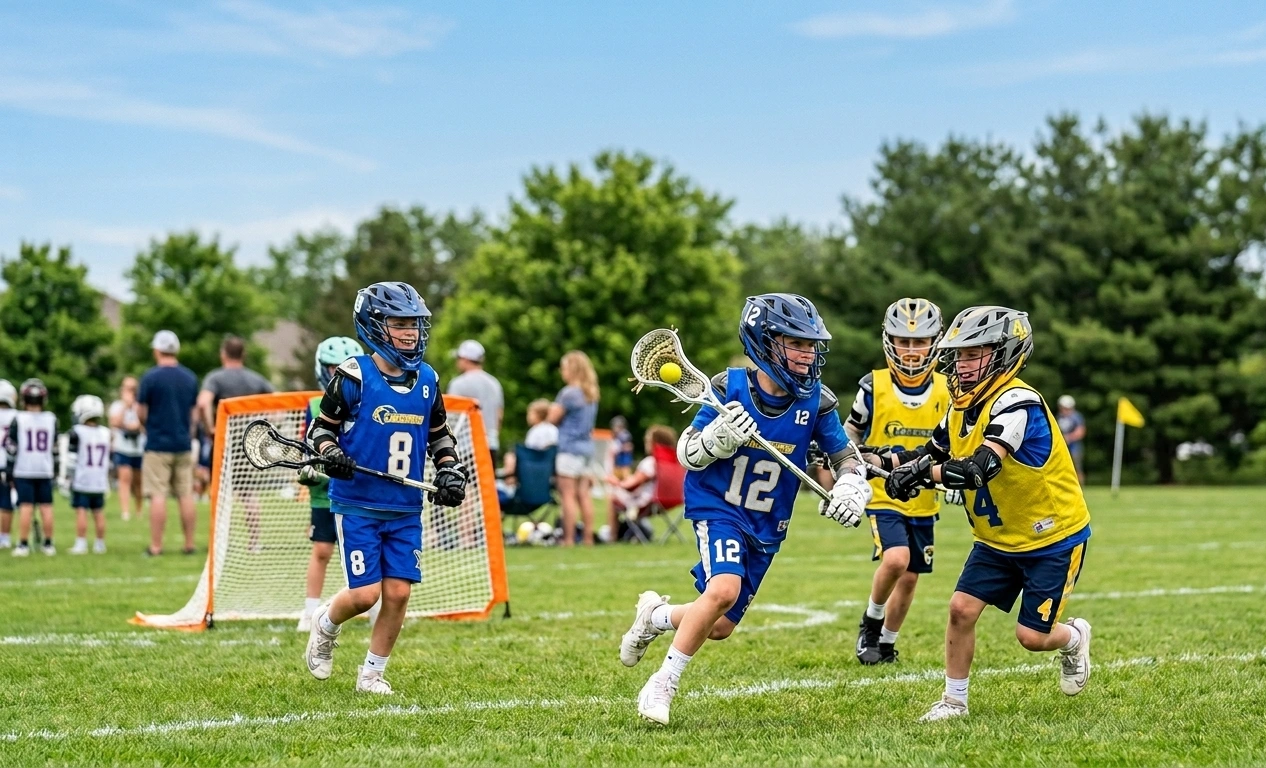
Why Youth Lacrosse Should Be Played 3v3 and 4v4 for Boys & Girls (On Smaller Fields)
If we truly care about long-term player development, then we have to stop asking our younger players, to compete in a version of the game that is built for high school and college athletes. Position Specific with Full or Modified fields that plays 7v7 & 10v10 lacrosse was not designed for U8, U10, & U12 Players, in my opinion.
3v3 and 4v4 on smaller playing areas isn’t a “modified” version of the game.
It’s a better version of the game for their stage of development.
Hear me out…
The Problem With Full-Field Model Lacrosse at Young Ages
When young players play full/modified field with specific positions like midfield, attack, and defense:
-
Most players barely touch the ball
-
The game becomes crowded and chaotic
-
Stronger players dominate possession
-
We get more standing than learning
-
Decision-making is limited
-
Fatigue replaces skill execution
For many players, a full-field game becomes “Run in a pack, hope the ball comes out.”
That’s not development. That’s survival.
What 3v3 and 4v4 Actually Do
When you shrink the space and reduce the number of players:
-
Every player is involved
-
Every player defends
-
Every player attacks
-
Every player makes decisions
-
Every player touches the ball, a lot
Small-sided games dramatically increase:
-
Ball touches
-
1v1 and uneven situations
-
Scanning and awareness
And most importantly: Decision-making under manageable pressure
This is how real learning happens.
- Check out this 3v3 game indoors, and see how the spacing is better, every kids is involved in the game, and high speed!
Small-Sided Games Align With How Kids Actually Learn
Research and modern coaching frameworks (like ecological dynamics and constraints-led learning) show that:
Skill emerges from solving problems in realistic, scaled, game-like environments.
Young athletes don’t learn best through:
-
Lines
-
Isolated drills
-
Over-coached sequences
They learn through:
-
Repetition in game-like environments
-
Adjusting to defenders
-
Recognizing space
-
Making mistakes and adapting
3v3 and 4v4 games or drills create:
-
More space per player
-
Clearer reads
-
Faster feedback loops
-
Repeated perception → decision → action cycles
That’s development.
- Here is a fun game that emphasizes ground balls, and then quick game recognition to find your open teammate!
The Cognitive & Physical Advantage
U8, U10, & U12 players are still developing their:
-
Visual scanning ability
-
Working memory
-
Spatial awareness
Full Field overloads these systems.
3v3 and 4v4 simplify the environment just enough so players can:
-
See space
-
Recognize numbers advantages
-
Understand give-and-go concepts
-
Learn off-ball movement
-
Develop defensive positioning & angles
Smaller games make the game readable.
Readable leads to confident.
Confident leads to creative.
Young athletes also lack:
-
The aerobic capacity for full-field transitions
-
The strength to throw long passes consistently
-
The speed to cover large distances repeatedly
Full-field games often become chaotic with:
-
Long clears
-
Missed passes
-
Turnovers
-
Scrums
Smaller fields allow:
-
Crisp passing
-
Quick transitions
-
skill-based play rather than pure speed
We want lacrosse IQ to develop before size and speed take over.
What 3v3 and 4v4 Build at Young Ages
Equal Development, Not Just Equal Playing Time
In 7v7: Some players may touch the ball 2–3 times in a game.
In 3v3: They might touch it 20–30 times.
That difference compounds over years.
Ball touches are the currency of development and you develop skillsets like:
For U8:
-
Cradling in traffic
-
Protecting stick
-
Ground ball technique
-
Simple passing decisions
-
Basic defensive pressure
For U10 & U12:
-
Spacing concepts
-
On and off ball play on both sides of the field
-
Two-man game understanding (More Ideal for U12)
-
Defensive Slide recognition (early awareness)
-
Transition reads & play, finding the advantages
You can teach principles instead of positions.
And principles scale as they age.
Critics will say “But That’s Not Real Lacrosse…”
Yes, it is.
Basketball does this.
Soccer does this.
Hockey does this.
They scale the environment to the athlete.
The full version of the game will come and if we rush to it too early, we build:
-
Low-confidence players
-
Players who avoid the ball
-
Players who never learned to read space
Small-sided games build problem-solvers.
If I Ran a Youth Lacrosse Organization, This Is the Game Model I’d Use
If the goal is real development, not optics, not tradition, not copying high school, then the structure must match the athlete. And we need to develop our young athletes for the Future. The Game of lacrosse is getting faster and faster with rule changes, like shot clocks. Every College and some HS play with shot clocks, and I think most all HS conferences will adopt in the near future.
U8: 3v3 Development League
Field Size
-
25 x 20 yards
-
Small goals
-
No goalies
-
No long poles
Format
-
8-12 players per team roster
-
3v3 on the field
-
3–4 minute shifts
-
Games played festival-style (multiple short games in one session)
Rules
-
No face-offs (start with pass-in after a goal or live ground ball to start)
-
Quick restarts
-
No riding/clearing pressure
-
All dead ball possessions begin with a pass or roll-in
Why?
At this age, we’re building:
-
Stick confidence
-
Ground ball habits
-
1v1 attacking
-
Defensive pressure
-
Playing with head up
Every player attacks.
Every player defends.
No hiding.
U10 & U12: 4v4 Game Model
Field Size
-
35–40 x 25–30 yards
-
Small or modified goals
-
Goalie in Play
-
No long poles
Format
-
10-12 players per team roster
-
4v4 on field
-
Short shifts (3–4 minutes)
-
Multiple games per day
Rules
-
Start with pass-in or roll-out
- 20 second Shot Clock! Have the kids play faster, and learn how to make mistakes and move on!
-
Quick transitions
- No free clears, pressure comes as soon as turnover happens
-
Encourage fast restarts
Why?
Now we build:
-
Spacing
-
Give-and-go play
-
Early two & three -player concepts
-
Defensive help awareness
-
Transition recognition
They begin to understand numbers advantages.
Practice Model & Coaching Standards
Practices & Training Days
If I ran the practices:
-
70% of practice = small-sided games
-
20% = constraint-based skill challenges
-
10% = direct instruction
Everything would be game-representative.
Coaching Standards
Every coach would be trained to:
-
Teach principles, not plays
-
Ask questions instead of giving answers.
-
Manipulate space and numbers as constraints
-
Prioritize touches over schemes
The standard would be: Are kids learning to solve problems on the fly?
Not: Did we win?
- Here is another fun drill that forces every player to find the advantage on the field, building their game IQ!
Tournament Structure
No full-field tournaments.
Instead:
-
Round-robin festivals
-
Multiple short games
-
Score kept lightly (or not emphasized)
-
Championship format optional but secondary
Development events, not travel showcases.
The Long-Term Vision
If we build our youngest players this way, then by U14 and early high school years:
-
Players understand spacing
-
They move off-ball instinctively
-
They defend with awareness both on an off ball
-
They can play vs pressure and under pressure
-
They have the confidence and want the ball
By JV and Varsity high school years, you’re not teaching basic concepts.
You’re refining them. Every player can adapt to any team system a coach may have in place.
The Hard Truth
Traditional models at 8 and 9 years old look impressive to adults.
Small-sided lacrosse looks messy.
But messy reps build skilled & adaptive players.
If development is truly the priority, then the structure must reflect it.