Foundational Skillsets
Jump to a Section
The practice is designed to bring value across multiple age levels. You can use this as a foundation to build and develop your own practice. With that being said, we highly encourage you to adjust the drills based on your team’s age and skill levels. Lacrosse Drive should always be used as a starting point — you can make drills easier or harder by changing the constraints.
To make a drill easier, you might Increase the playing area, reduce the number of defenders or rules, add time or space to make decisions
To make a drill harder, you might: Shrink the field or add boundaries, add defenders or touch restrictions (e.g., “one-pass before shooting”), or Limit time or space to force faster decisions
Small adjustments to field size, player numbers, and rules can significantly change the challenge level while maintaining the same core learning goal.
Practice Theme & Objective
This practice is designed to lay the groundwork for the fundamental skills and principles we want our players to understand and build upon. Becoming comfortable with handling the lacrosse stick is one of the most important aspects of the game. The more confident and natural a player feels with their stick, the easier it becomes to grow and develop as a player. During this session, continue to emphasize the key coaching points and principles outlined in each drill. It’s important for players to understand that no matter their current skill level, there’s always room to improve the basics of stick handling.
At the end of practice, engage the players by asking reflective questions such as:
- “What did you learn today?”
- “Which drill did you enjoy most, and why?”
Encouraging discussion helps reinforce learning and keeps players mentally involved in their development.
Stick Fundamentals
We want players, especially new to the game, to hold and carry the stick the right way. Often, players who have been playing for a few years don’t always have the right habits and can always use reinforcement.
Setup
Kids set up in a big circle with coaches inside. Every player should have a ball. Kids will start this.
Principles & Coaching Points
- Top hand is control hand (stick in fingers, not palm); bottom hand is anchor hand.
- Keep the stick vertical so it remains around the ears or chin.
- Use the control hand’s wrist motion to cradle the stick back and forth while the anchor hand holds steady.
Progressions
- Have players run in a circle around the coach, carrying and cradling the ball.
Stick Skills - Partner Passing
Establishing a proper way to throw and catch is paramount. This is a basic drill where efficiency can be determined by how we set up the drill and what we expect players to do.
Setup
Players pair up and stand about 5 yards apart. The goal is to play catch back and forth while maintaining proper hand and body positioning throughout the drill.
Principles and Coaching Points
- Stand like you’re on a “surfboard” — hips and shoulders pointed toward your teammate.
- Stick in right hand, lead with left foot; stick in left hand, lead with right foot.
- Throwing: Anchor hand is at the bottom of the shaft; control hand is about 10–12” above the anchor.
- Keep hands and elbows high, using the control hand to snap the pass.
- Catching: Move the control hand up toward the top of the shaft, near the bottom of the stick head.
- Keep your stick up as a target and watch the ball into your pocket with soft hands — as if catching an egg or water balloon.
Progressions
- Have players use their opposite hand to develop off-hand coordination.
- Increase the distance to 10 yards to practice longer, more powerful passes.
5 Player Line Drills – Ground Balls
This is a great drill to focus on ground balls and stick control. We use this drill to help players practice the core principles of ground balls and stick protection immediately after gaining possession.
Setup
Place players in groups of 4 or 5 along the sidelines facing the middle of the field. Each group should be spaced at least 15–20 yards apart. In front of each line, set a cone approximately 10 yards away. A coach or player holds a stick at waist height over a ball. Player (A) must scoop the ball by going under the stick, then carry it while curling around the cone with the stick kept outside and close to the body while cradling.
Principles & Coaching Points
- Get low to scoop the ball.
- Scoop and bring the stick close to your body — “kiss the stick.”
- Carry the ball around the cone, keeping the stick to the outside (imagine a defender on you).
Progressions
- Have a player or coach hold the stick directly over the ball to add slight pressure during the scoop.
- Allow a teammate to make a light check on the stick head as the player scoops to simulate defensive pressure.
Summary
A foundational ground ball drill for early learning!
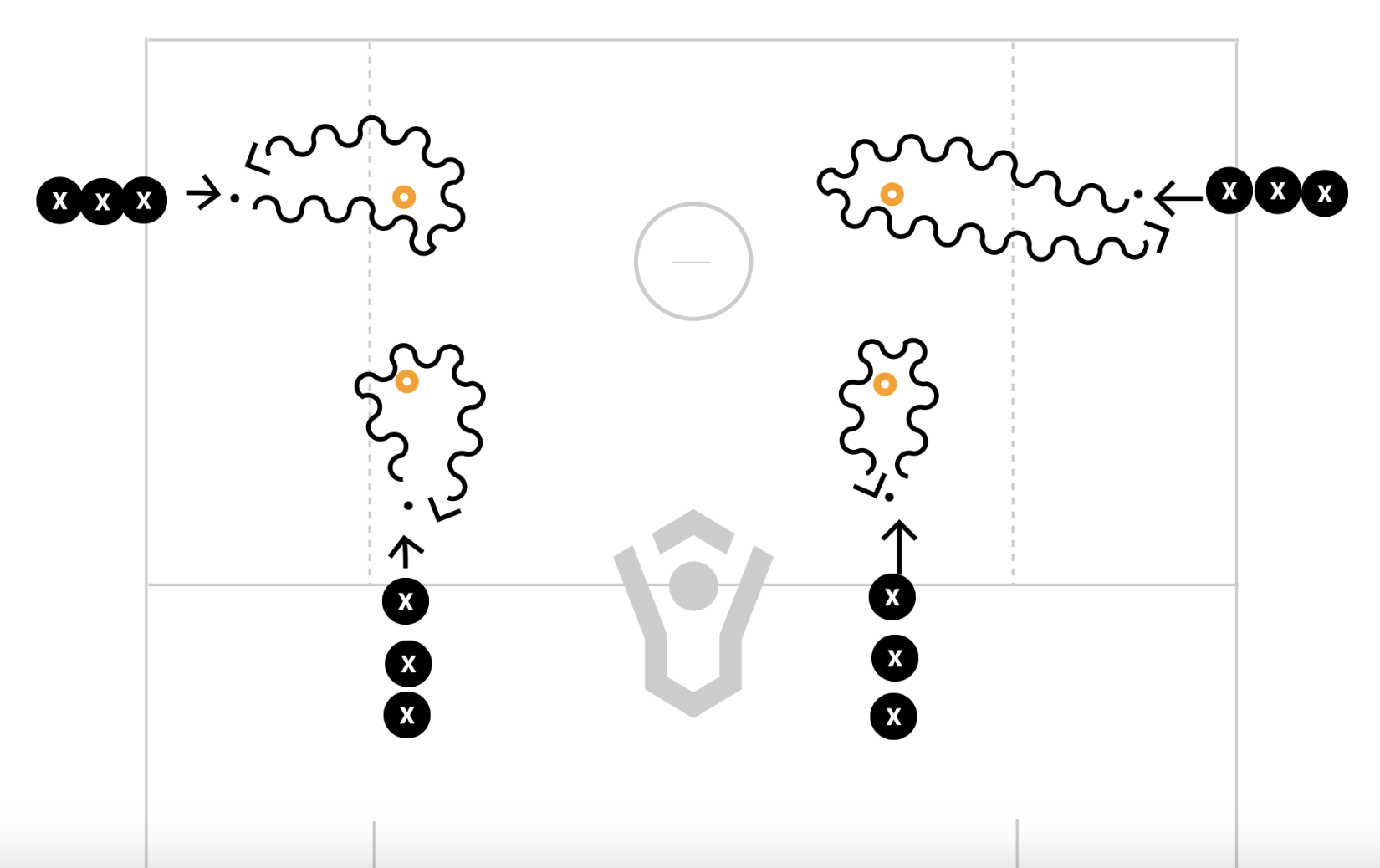
Zig Zag Stick Protection w/ Ground Ball & Shot
This drill is designed to enhance the players overall stick and ball control with some agility work built in so they can start learning how to change direction while protecting the ball.
3 V 1 Player Box Passing
Summary
A great pre-practice drill to work on team passing
Tags
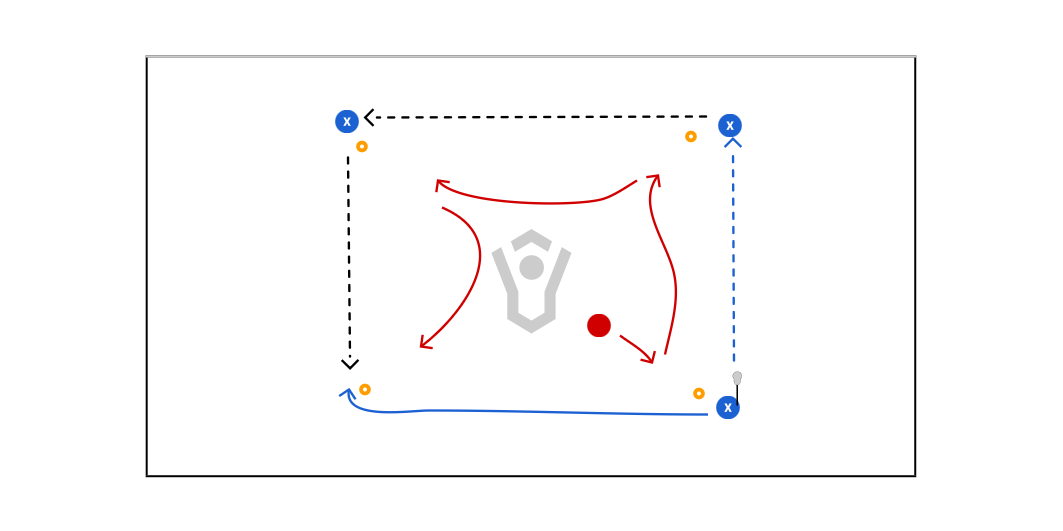
Set Up
Create a box using 4 cones, about 10 yards apart. Place 3 offensive players on the outside and 1 defender in the middle. The offense must stay outside the box, while the defender stays inside. They play keep away, and the cones are used as gudaicne for the off ball teammates to move to proper passing lanes. If the defender steals the ball or bad pass occurs, swap with the offense player!
Coaching Points & Principles
- Moving your feet with and without the ball
- Good passing and catching mechanics
- Defense keep stick up in passing lanes
Progressions
- Add a defender in to play 3v2
Tight 1v1
Playing with some contact, allows the offensive player to “feel” the defender on them, and naturally try and move in the other direction, which is why Tight 1 V 1 is a great introduction to dodging. This is a foundation for on ball defense and offense, and playing in space
Summary
For young players, this is a good drill to work on understanding body position when dodging toward the goal
Tags
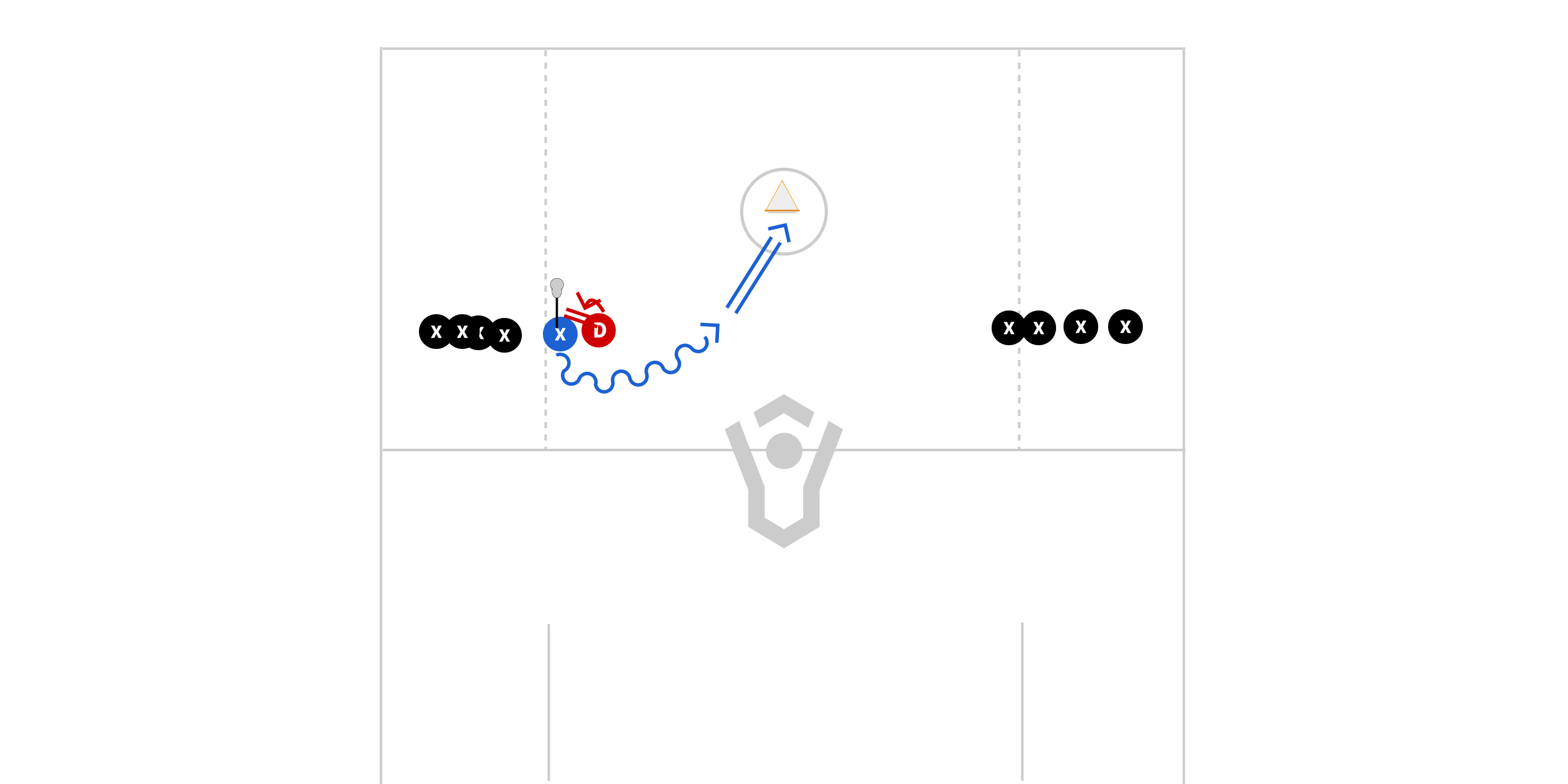
Set Up
Put an offense and defense player in play. They start with the offense shielding stick with body, leaning into the defender. The defense leans back with hands/stick on hip on opponent. On whistle, the offense player attacks the goal, and does so by feeling the weight/positon of the defender, and attacking the opposite.
Coaching Points & Principles
- Stick Protection!
- Use Body to feel the pressure angle from defender.. roll dodges and top side drives will work but find the natural escape
- Defense work on recovery angles
- Do this drill from all areas of the field
Progressions
Have players start with small separation, so the defense must approach.
Setting Up Drills for Success
Small Groups
Keeping the kids in small groups, allows for more touch counts and allows for drills to continue moving if some are struggling more than others.
Limit Stoppages
Try to keep drills and practice moving. If a few players are struggling with a drill or concept, pull aside and give personal attention. If the whole group is struggling, try to simplify a drill by taking away 1 element.